Legal Fish Size Limits by State: Complete Guide
Why Legal Size Limits Exist
Legal size limits are one of the oldest and most effective tools in Australian fisheries management. A minimum legal length gives each fish the chance to spawn at least once before it can be taken home, protecting the breeding stock that keeps a fishery productive. Some species also carry a maximum size limit, which shields the large, highly fertile breeders that produce the most eggs. Combined with bag limits, gear restrictions and seasonal closures, size rules spread fishing pressure so that popular estuaries around Sydney and along the coast can support anglers year after year.
Every Australian state and territory sets its own size limits, and they are not identical. A bream that is legal in one jurisdiction may be undersize a few hundred kilometres away across a border. If you fish interstate, treat each trip as a fresh homework task rather than assuming your home-state knowledge travels with you.
Minimum, Maximum and Slot Limits
- Minimum legal length - the fish must be at least this long to keep. Anything shorter must be returned to the water immediately with the least possible harm.
- Maximum legal length - applied to species where large individuals are the most valuable spawners, such as some barramundi and Murray cod populations.
- Slot limits - a legal window between a minimum and a maximum, so only mid-sized fish may be retained.
- No-take species - protected fish that cannot be kept at any size, including many sharks, rays, seahorses and listed freshwater natives.
How to Measure a Fish Correctly
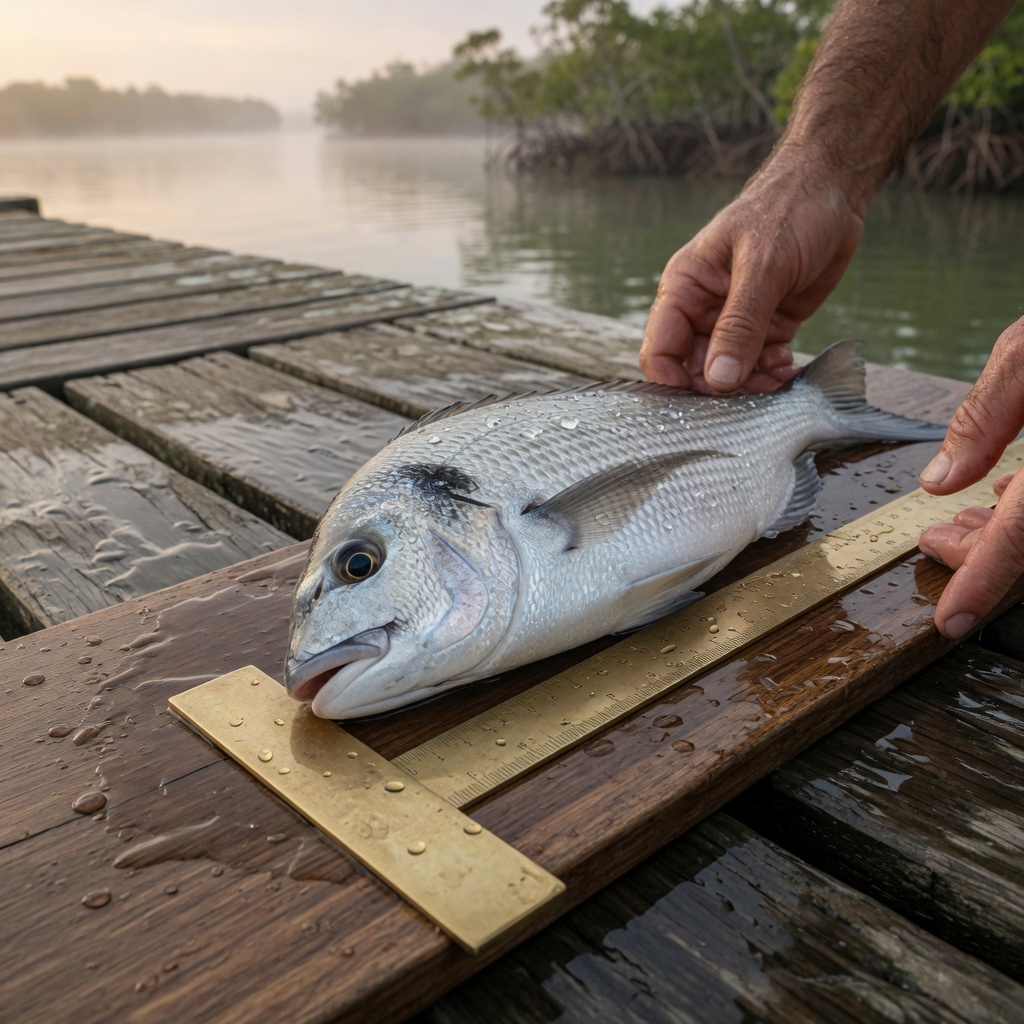
Most Australian jurisdictions measure finfish as total length: from the tip of the snout or upper jaw to the tip of the tail, with the tail lobes squeezed together to give the longest possible measurement. Some species are measured differently, and it pays to know which apply where you fish:
- Fork length - snout to the V of the tail fork, used for certain tuna and mackerel species.
- Carapace length or width - used for crabs, rock lobster and some crustaceans.
- Shell length - used for abalone and other molluscs.
Carry a rigid measuring device rather than guessing. A brag mat, a ruler taped to the gunwale or a marked rod butt all work. Measure the fish while it is wet and flat, decide quickly, and if it is borderline, release it. Fisheries officers measure the fish as presented, and honest mistakes are still offences.
State-by-State Differences to Watch
Size limits vary because fish grow, mature and spawn differently in different waters. Points where states commonly diverge include:
- Coastal favourites such as bream, flathead, snapper, whiting and mulloway often have different minimum lengths in New South Wales, Victoria, South Australia, Western Australia, Queensland and Tasmania.
- Tropical species such as barramundi and coral trout carry size and seasonal rules specific to Queensland, the Northern Territory and northern Western Australia.
- Freshwater natives including Murray cod and golden perch are managed under both size limits and closed seasons that differ between the Murray-Darling states.
- Some waters carry special local rules - impoundments, stocked dams, aquatic reserves and marine park zones can override general statewide limits.
Because the numbers are reviewed and adjusted by each fisheries agency, Fishing Licence Australia does not publish a fixed table of centimetres. Instead, use this guide to understand how the system works, then confirm the current figure for your species and location with the official state fisheries publication or app before you keep a fish.
Size Limits, Bag Limits and Possession Limits Together
A legal-sized fish still has to fit within your daily bag limit and your total possession limit, which covers fish held at home, in a camp fridge, in an esky or in transit. For a deeper explanation of how daily catch and possession rules interact with size limits, see our guide to bag limits, possession limits and legal size rules. If you are still sorting out your paperwork, start with the general licensing and regulations overview for your state.
Releasing Undersize Fish Responsibly
- Wet your hands or use a knotless landing net to protect scales and slime.
- Support the fish horizontally and avoid holding it by the gills or jaw hinge.
- Use pliers or a dehooker, and cut the line close if the hook is swallowed deeply.
- Keep air exposure short - measure, decide and release within seconds where possible.
- For deep-caught fish showing barotrauma, use a release weight or venting tool where permitted.
Before You Fish: A Quick Checklist
- Confirm whether a recreational fishing licence or permit is required for your water and gear.
- Check the current minimum, maximum or slot limit for each target species in that jurisdiction.
- Note protected and no-take species so you can identify and release them.
- Check whether a seasonal closure, marine park zone or spawning closure applies.
- Pack a measuring device, a knotless net and release tools.
Questions about how these rules apply to a planned trip? Contact Fishing Licence Australia on +61250701250 or at [email protected] during Mon–Fri: 09:00 – 17:00 (AEST). We help anglers interpret published fisheries information; final authority always rests with the relevant state or territory fisheries agency.
Navigation
See also
FAQ