Catch and Release Rules in Australia Explained
What Catch and Release Actually Means Under Australian Rules
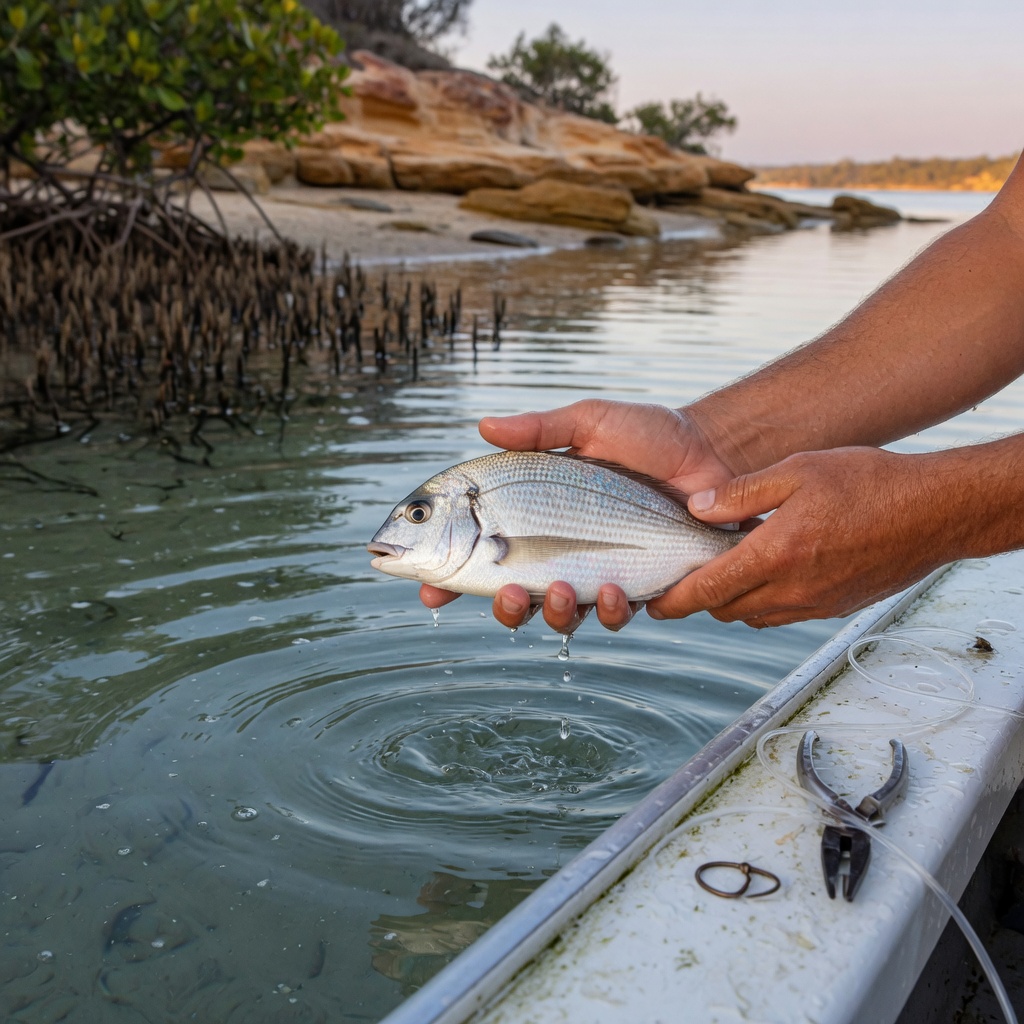
Catch and release is the practice of returning a fish to the water alive after capture. In Australia it is partly a voluntary conservation choice and partly a legal requirement. Anglers must release any fish that is undersized, oversized, out of season, over the bag limit, a protected species, or taken inside a no-take zone. Releasing a fish does not simply mean throwing it back; fisheries rules across the states expect the fish to be returned with the least possible harm, and careless handling of a fish you were never allowed to keep can still be treated as a breach.
For anglers fishing in and around Sydney, this matters every session. Estuary, harbour and offshore waters all hold species with different minimum legal lengths, and some — such as certain protected groupers, sawfish, and freshwater cod outside open seasons — must be released immediately no matter how they were hooked.
When Release Is Compulsory
- Undersized fish — any fish below the minimum legal length for that species and jurisdiction must go back straight away.
- Maximum size or slot limits — some species, including certain barramundi and mulloway populations, have upper size limits to protect large breeding fish.
- Bag and possession limits reached — once you hold your daily limit, every further fish of that species must be released.
- Protected and totally protected species — these cannot be retained under any circumstances and should not be lifted from the water unnecessarily.
- Seasonal closures — during spawning closures a species may be off-limits entirely, and in some closures targeting it is also prohibited.
- Sanctuary and no-take zones — inside marine park sanctuary zones, fishing itself is usually banned; if you are in a habitat protection or special purpose zone, check the specific zoning rules before you cast.
How to Release a Fish Properly
- Decide before you land it. If the fish is clearly a species you cannot keep, plan to release it at the boat or water's edge without a long fight or a photo session.
- Keep it wet. Minimise air exposure — aim for seconds, not minutes. Wet your hands or use a wet cloth rather than a dry towel, which strips protective slime.
- Support the body. Hold the fish horizontally with two hands; never suspend a large fish by the jaw alone, as this can damage the spine and internal organs.
- Use the right net. Knotless, rubberised landing nets cause far less scale and fin damage than knotted mesh.
- Cut the line on deep hooks. If a hook is swallowed, cutting the line close to the mouth generally gives better survival than digging the hook out.
- Revive before letting go. Hold the fish facing into gentle current or move it slowly forward until it swims off under its own power.
Gear Choices That Improve Survival
Tackle selection is the simplest way to lift release survival rates. Circle hooks reduce deep hooking in bait fishing. Single hooks in place of trebles on lures cut down on facial and eye damage and make unhooking quicker. Crushing barbs or using barbless hooks speeds release, particularly in freshwater trout and bass fishing. Heavier line that lets you land a fish quickly reduces exhaustion, which is a major cause of delayed mortality in warm water.
Release weights and venting tools are used for fish caught in deeper water that suffer barotrauma — swollen swim bladders, bulging eyes or a stomach protruding from the mouth. Many state fisheries agencies recommend a weighted descending device to return the fish to depth rather than leaving it floating on the surface where it will not survive.
Freshwater Versus Saltwater Considerations
Freshwater species in inland New South Wales, such as Murray cod and golden perch, are affected by high summer water temperatures. When water is very warm, dissolved oxygen is low and released fish struggle to recover, so many anglers shorten fights, avoid handling entirely and skip photos. In saltwater, sharks and rays should be released without being dragged up a beach or across rocks, and pelagic species handled at the boat with the engine in gear only when safe.
Licences, Records and Staying Compliant
Catch and release does not remove the need for a recreational fishing licence or permit where one applies. In New South Wales a recreational fishing fee applies to most saltwater and freshwater line fishing, including when you intend to release everything you catch, with limited exemptions. Always confirm current requirements with the relevant state fisheries authority before you fish, and carry proof of payment or exemption.
Keeping a simple log of species, lengths and locations helps you learn local size limits and shows good faith if you are checked by a fisheries officer. If a rule is unclear — a zoning boundary, a closure date or a species identification — the safest course is release.
Getting Help From Fishing Licence Australia
Fishing Licence Australia brings together state-by-state guidance on licences, bag limits, legal lengths, seasonal closures and marine park zoning so you can check the rules before you leave home. If you have a question about release requirements for a particular species or waterway near Sydney, contact us on +61250701250 or at [email protected] during Mon–Fri: 09:00 – 17:00 (AEST), and we will point you to the official fisheries source that applies to your trip.
Navigation
See also
FAQ